Say you're touring a renovated 1930s bungalow two blocks off Big Stacy Park. The listing agent mentions, almost in passing, that the house has been running as an Airbnb for the past two years, with a five-star rating and a calendar that's booked solid through October. The math in your head writes itself: buy the house, keep the listing live, collect the income that's already proven itself.
That math is wrong, and not because the income projection is off. It's wrong because the license that makes that income legal doesn't transfer with the house. What you're actually buying is a property with someone else's rental history attached to a piece of paper that expires the moment the deed changes hands.
The License Follows the Person, Not the House
Austin regulates short-term rentals, defined as any stay of fewer than 30 consecutive days, through Chapter 4-23 of the city code. Every operator needs a license, and the city issues three types depending on how the property is used: Type 1 for owner-occupied homes, Type 2 for non-owner-occupied whole-home rentals, and Type 3 for multifamily buildings.
A new license currently runs $836.30, made up of a $789 base fee plus a $47.30 neighbor notification charge. Renewal costs $385.30 and now covers a two-year term instead of one. Both fees are non-refundable, whether the city approves the application or not. Processing takes four to six weeks for Type 1 and Type 2 applications, and eight to ten weeks for Type 3.
None of that transfers at closing. A seller's active license lapses with the sale, and the buyer starts the clock over from zero.
| License Type | Who Qualifies | Typical Processing Time | Cost |
|---|---|---|---|
| Type 1 | Owner-occupied home or associated unit | 4-6 weeks | $836.30 new / $385.30 renewal |
| Type 2 | Non-owner-occupied, whole-home rental | 4-6 weeks | $836.30 new / $385.30 renewal |
| Type 3 | Multifamily property | 8-10 weeks | $836.30 new / $385.30 renewal |
If the plan is to keep the listing live the week you get the keys, that plan needs a six-week buffer built into it, minimum.
Why the July 1 Deadline Raised the Stakes
This isn't a theoretical compliance risk anymore. As of July 1, 2026, platforms including Airbnb and VRBO are required to display a valid license number on every Austin listing and remove unlicensed properties within 10 days of a city request. Before that date, an unlicensed listing could linger for months. Now it can't.
The city has also been checking its work. Staff began scraping listings for compliance in January 2026 and had flagged 2,785 unlicensed addresses across Austin by April 1 of that year. That number matters for a Travis Heights buyer specifically, because a seller marketing "proven Airbnb income" on a listing sheet is making a claim about revenue, not about licensing. Those are two different questions, and only one of them has been verified by a third party.
Before you write an offer on a property being marketed with existing short-term rental income, ask for the license number and the license type. If the seller can't produce one, the income history you're underwriting against may not have been legal to generate in the first place, and it's certainly not something you can rely on going forward.
The Caps That Follow the Address, Not the Owner
Even a fully compliant seller's license doesn't guarantee you'll qualify for the same one. Austin's rules attach some restrictions to the address and the operator combination, not just the property.
Non-owner-occupied Type 2 operators running more than one short-term rental have to keep those properties at least 1,000 feet apart. In multifamily buildings, no more than 10% of units can operate as short-term rentals at once. Travis Heights is a dense, walkable pocket of Austin, which is exactly the kind of neighborhood where an investor is likely to already own a nearby property. If you're that buyer, the 1,000-foot rule is worth checking against a map before you assume a Type 2 license is available to you at all.
The Carriage House Complication
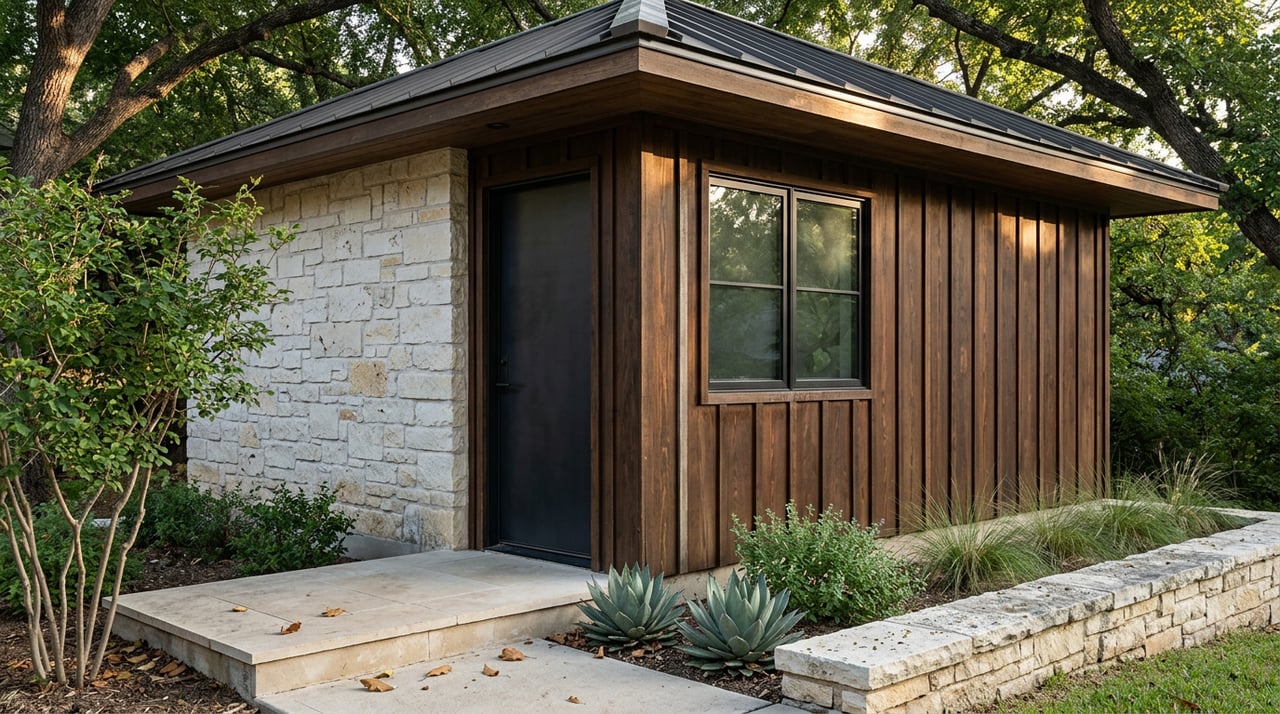
Travis Heights has a housing stock that's unusual for how much of it predates modern construction. A share of the neighborhood's older homes still have the detached garages or carriage houses that were common accessory structures decades ago, and many of those have since been converted into small standalone apartments.
That history creates a specific trap for STR-minded buyers. If a detached unit qualifies as an accessory dwelling unit built after October 1, 2015, Austin caps its short-term rental use at 30 days per calendar year, full stop. Licensing status doesn't change that number. A buyer who sees "guest house currently listed on Airbnb" and assumes year-round income potential needs to check the permit date on that structure before the assumption goes any further.
Austin's zoning code says short-term rental use cannot be prohibited in any zoning district. Private agreements can still say otherwise. HOAs and deed restrictions operate independently of city zoning, and neither the license nor the zoning code overrides a covenant that limits rental activity on a specific block.
What the Comps Actually Say About the Math
Recent MLS activity puts Travis Heights sale prices roughly between $900,000 and $1.1 million as of early August 2026, with price per square foot climbing into the high $600s and low $700s, well above where it stood a year earlier. Inventory stays thin, with well under 100 active listings at a time in a neighborhood built out with a fixed and limited number of lots.
Set that against citywide short-term rental performance. Austin's average monthly revenue per listing ran $2,794 over the trailing twelve months through early 2026, with a 57.7% occupancy rate and an average daily rate near $225, swinging from a high of 67.7% occupancy in March during SXSW down to 46.7% in January.
Run that average revenue figure against the licensing timeline. A buyer closing on a $950,000 Travis Heights property and waiting the standard four to six weeks for a Type 1 or Type 2 license is looking at roughly a month and a half without legal STR income, which at the citywide average works out to somewhere around $3,000 to $4,000 in lost revenue. That's on top of the $836.30 license fee itself. The real closing-day cost of STR ambition in this neighborhood isn't the filing fee. It's the carrying cost of a vacancy period the seller's marketing sheet never mentioned.
What to Verify Before You Write the Offer
A few steps, done before the offer goes in rather than during the option period, save a lot of frustration later.
- Pull the current license status and type for the address directly, and cross-check it against what the seller claims.
- Ask the seller to provide the license number in writing and confirm it's active, not expired or pending renewal.
- If any part of the property was built as an accessory structure after October 1, 2015, confirm the permit date before assuming full-time STR use is possible.
- If you already own another short-term rental in or near Travis Heights, measure the distance before assuming a Type 2 license transfers to your situation.
- Check the deed and, if applicable, any HOA documents for private restrictions on short-term or transient rental use, since city zoning approval doesn't override them.
FAQ
If the seller has a Type 1 owner-occupied license, can I just take it over? No. Type 1 licenses are tied to owner-occupancy status, and the license itself doesn't transfer to a new owner under any type. Every buyer applies fresh, regardless of what license the seller held.
What if the seller's current Airbnb income was never actually licensed? Treat that income history as informational at best, not as something you can underwrite. Unlicensed operation is precisely what the city has been identifying since it started scraping listings in January 2026, and it carries no guarantee that a license will be approved for the same use going forward.
Does a detached carriage house or garage apartment need its own license, separate from the main house? Yes. Licenses are issued by unit and location, so a main house and a detached accessory unit are considered separately. The accessory unit's permit date determines whether the 30-day annual cap applies, independent of whether either unit is licensed.
If you're weighing a Travis Heights purchase with short-term rental income in the plan, the timeline and the caps deserve as much scrutiny as the price per square foot. I've walked buyers through exactly this kind of due diligence in Travis Heights and the neighborhoods around it, and I'd rather find the friction with you before the offer than after the option period ends. Reach out to Amy Sparks to book a personalized consultation and get a clear read on what a specific address can and can't do under Austin's current rules.